INTERNATIONAL NEWS / MODERNIZATION
The Money Is in Old Elevators
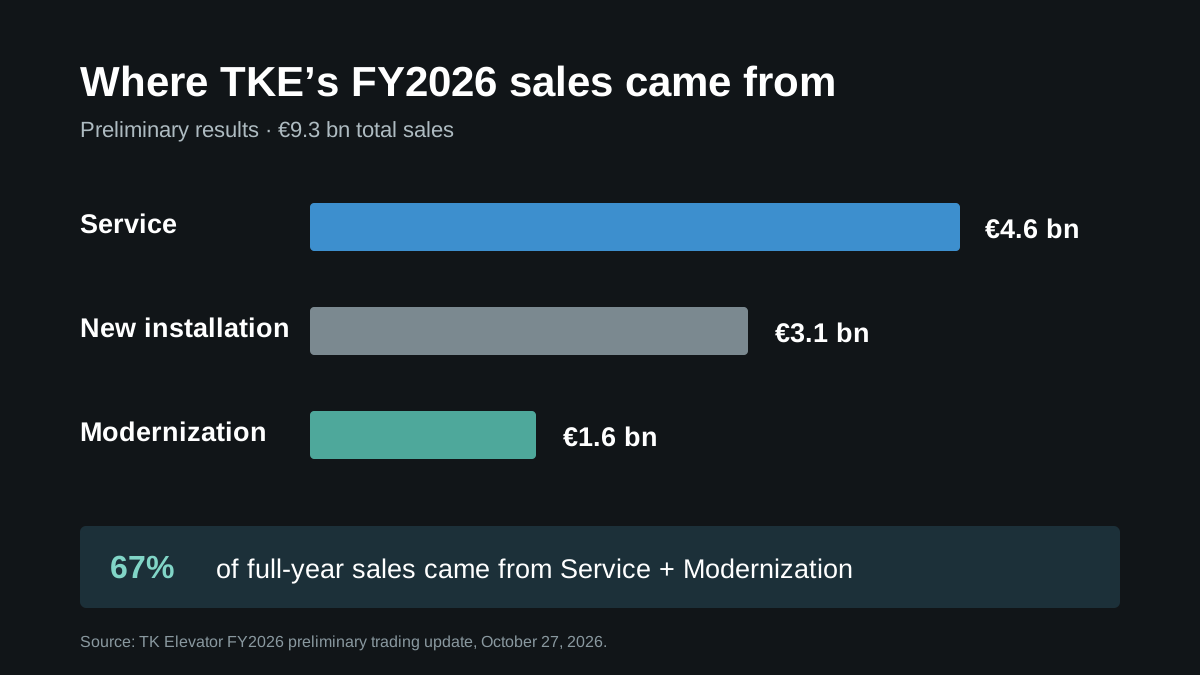
TK Elevator just reported its best financial year. The meaningful number is not only €9.3 billion in sales. It is where that money came from: two-thirds was earned on elevators already standing in buildings. For Manitoba owners, that is not distant European finance news. It is a useful picture of what the next decade of elevator work is likely to look like.
A record year built on existing elevators
TK Elevator reported FY2026 sales of €9.3 billion, adjusted EBITDA of €1.72 billion and order intake of €9.7 billion. The company describes the results as preliminary and unaudited. Its operating story was driven by service and modernization: €4.6 billion in service and €1.6 billion in modernization, together representing 67% of sales.
Only €3.1 billion came from new installation. In the final quarter, TKE said modernization orders grew 27%. That difference matters because it shows where the industry is finding growth: not principally in building more shafts, but in rebuilding the systems already inside them.
The same pattern across the major manufacturers
TKE is not alone. KONE reported modernization as the key driver of order growth in its third-quarter update. Otis reported modernization-order growth and a larger modernization backlog while new-equipment sales in China remained soft. Different companies are describing the same shift: an aging installed fleet and the need for better reliability, energy performance and digital controls are producing work long after the original installation contract ends.
That does not mean new construction disappears. It means the business of caring for old equipment is becoming the centre of gravity.
What “modernization” actually means
Modernization is not a cosmetic cab refresh. It is planned replacement of systems that wear out, become obsolete or no longer support the way a building operates — while the shaft, rails and much of the structure remain in place.
- Hydraulic elevators: a package may replace the power unit, controller and fixtures while keeping the main installation in place.
- Geared traction elevators: modernization can renew the controller and safety systems or convert an older geared machine to a gearless drive with a variable-frequency AC drive.
- Door equipment: door operators and reopening protection can be staged as their own scope instead of waiting for a full replacement.
- The digital layer: remote condition monitoring and destination dispatch can be added to an existing group where the building’s traffic pattern justifies it.
Major manufacturers routinely market modernization for more than their own brands. An older Otis, Dover, Montgomery or other installation can be a candidate. The important question is not the badge on the car; it is the condition, supportability and performance of the systems inside it.
Why phased work matters in Manitoba
Manitoba’s new Technical Safety Act regime for elevating devices took effect on September 1, 2026. The province adopted ASME A17.1/CSA B44:19 and introduced new recordkeeping and testing requirements. That makes a “we will deal with it someday” approach harder to defend when a known component is approaching a test or reliability problem.
There is a useful practical principle in ITS 26-004: modernizations and alterations do not automatically require every part of an elevator to be upgraded. The specific component or system being altered must meet the newly adopted code; parts outside the scope are not automatically pulled into the project.
That is why staged modernization is legitimate planning, not a shortcut. An owner can address a controller, door system or power unit when it needs attention, provided the work is properly scoped, documented and accepted.
The CAT 5 calendar makes planning real
Manitoba’s periodic safety-testing program uses a fixed ladder: Category 1 annually, Category 3 every three years and the more extensive Category 5 full-load test every five years. The first CAT 5 deadlines are phased by the date a device was installed or altered.
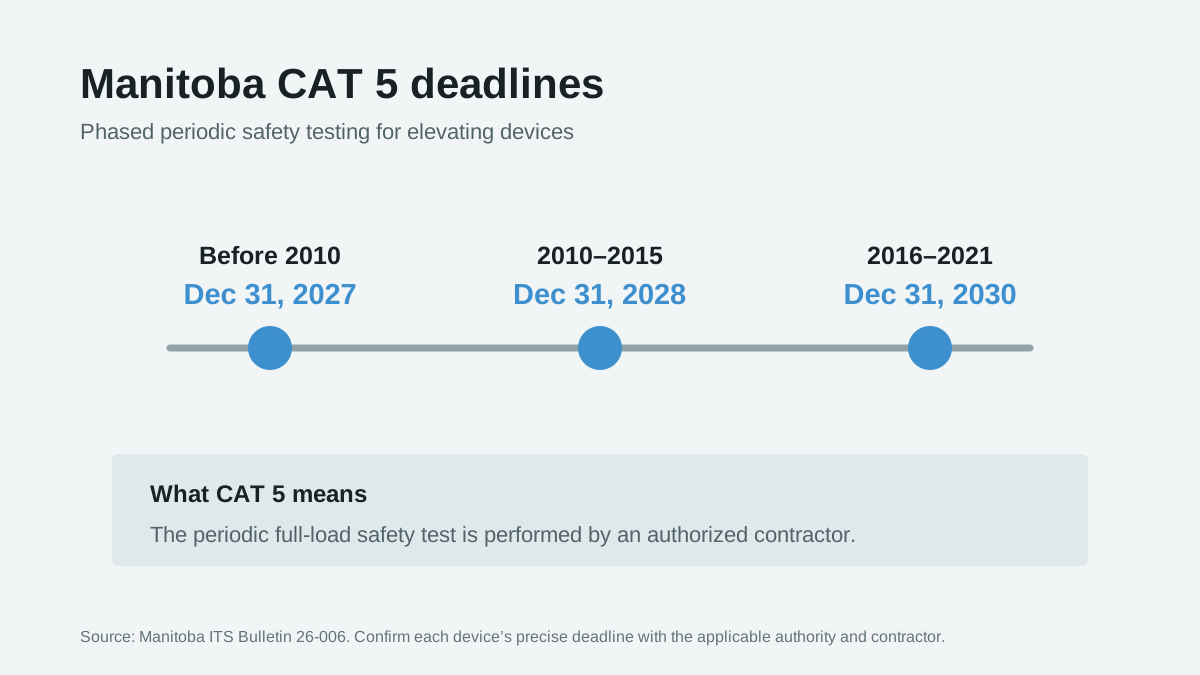
For a building facing a Category 5 deadline with an aging controller, the choices are clearer: test and repair the existing system, replace the specific failing systems or plan modernization in time to avoid an emergency shutdown. A failed safety-test item can take an elevator out of service; a planned project gives owners more choice about scope, cost and scheduling.
What an owner should ask before signing
Modernization proposals can look bigger than they need to be. A useful first conversation is not “What is the price?” but “What problem does each proposed item solve?” Ask for the current condition, the test or reliability reason, the code basis, the expected remaining life of retained equipment and whether the work can be phased.
Ask as well what will remain proprietary after the work: the controller, diagnostic access, remote-monitoring platform and the ability of other qualified contractors to service the equipment. Those questions belong in the project before the contract turns into a long service relationship.
The takeaway
TKE’s record figures are company results, not a Manitoba forecast. But the direction is clear. The industry is earning more of its money from keeping existing elevators safe, reliable and useful. For owners, the sensible response is not panic or a blanket replacement. It is to know the test calendar, keep complete records and make modernization decisions before the equipment makes them for you.
Sources and verification
TK Elevator — FY2026 preliminary trading update, October 27, 2026
TK Elevator North America — elevator modernization overview
Manitoba ITS Bulletin 26-004 — Code Adoption for Elevating Devices
Additional reporting reviewed: KONE January–September 2026 interim report; Otis Q3 2026 results; Manitoba ITS Bulletins 26-005 and 26-006. TKE’s financial figures are preliminary and unaudited as stated by the company. This article is general reporting, not a code interpretation or procurement recommendation.