INTERNATIONAL NEWS / INDUSTRY NEWS
The Elevator Business Is Shifting Toward the Buildings Already Standing
Four major elevator companies have reported their latest results. Their figures differ, but the common signal is clear: existing equipment is driving much of the industry’s growth.
A new elevator begins its life on a construction site. After the handover, someone has to keep it running for decades, repair what wears out, and eventually decide what to replace. The latest financial releases from Otis, KONE, Schindler and TK Elevator suggest that the second part of that life cycle is becoming increasingly important to their businesses.
These are not four identical annual reports. TK Elevator (TKE) released preliminary, unaudited full-year results for the fiscal year ended September 30, 2026. Otis and KONE reported the third quarter and the first nine months of calendar 2026; Schindler published key figures for those same periods. Their currencies, accounting measures and definitions of growth differ. The useful comparison is the direction of each business, not a league table of their margins.
| Company | Latest reported signal | What it measures |
|---|---|---|
| TKE | Service and modernization made up 67% of full-year sales. Fourth-quarter modernization orders rose 27%. | Revenue mix over TKE’s fiscal year; new bookings in its final quarter. |
| Otis | Third-quarter service sales rose 8%; organic modernization sales rose 20% and modernization orders rose 10% at constant currency. | Revenue recognized during the quarter; separately, new bookings. |
| KONE | Third-quarter sales rose 5.2%. KONE identified modernization as the main driver of order growth. | Group sales, plus management’s description of the order mix. |
| Schindler | Nine-month order intake rose 5.2% and revenue 2.6% in local currencies; it reported strong modernization growth and steady service growth. | Group orders and revenue. Its press release gives no separate growth percentage for either business line. |
Sources: TKE, October 27; Otis, October 28; KONE, October 28; Schindler, October 22.
The installed base is the story
TKE now maintains more than 1.4 million units worldwide. Its full-year service sales reached €4.6 billion, up 5% on the company’s currency-adjusted comparison, while modernization sales exceeded €1.6 billion, up 7%. Those figures help explain why service and modernization together accounted for roughly two-thirds of its annual sales. The 27% rise in fourth-quarter modernization orders is a separate measure: projects booked now will become revenue as work is carried out. TKE’s release is explicit that its full-year figures are preliminary and unaudited.
Otis offers a useful distinction within its own service segment. Third-quarter organic maintenance and repair sales grew 4%, while organic modernization sales grew 20%. Its modernization order backlog was up 20% year over year. In other words, the company reported both more modernization work recognized as sales and a larger queue of work still to deliver. Those measures are related, but they are not interchangeable. Otis’s release also says its adjusted operating profit for the whole company slipped despite higher sales, a reminder that revenue growth does not automatically mean easier economics.
KONE describes service and modernization as the strongest market opportunities across its regions. It links modernization demand to aging equipment, energy efficiency and the need to adapt buildings. Schindler reports the same broad pattern: modernization orders are growing strongly and service continues to expand at a steadier pace. The companies do not all disclose the same segment figures, so the evidence supports a shared trend, not a precise claim about which of the four is growing modernization fastest. KONE’s report · Schindler’s release (PDF)
New installations tell a regional story
The results do not say that new installations are disappearing. Otis’s third-quarter new-equipment sales rose 3%. Its growth in the Americas, Europe, the Middle East, Africa and Asia-Pacific outweighed a decline of more than 20% in China. TKE says new-installation growth in Europe and the Americas offset weakness in China and South Korea. KONE says the North American new-building market declined slightly in the third quarter, Europe was stable, and China remained weak. These are different companies measuring different activities, but all three show why a global headline can conceal very different local markets. Otis · TKE · KONE
What this means for the trade
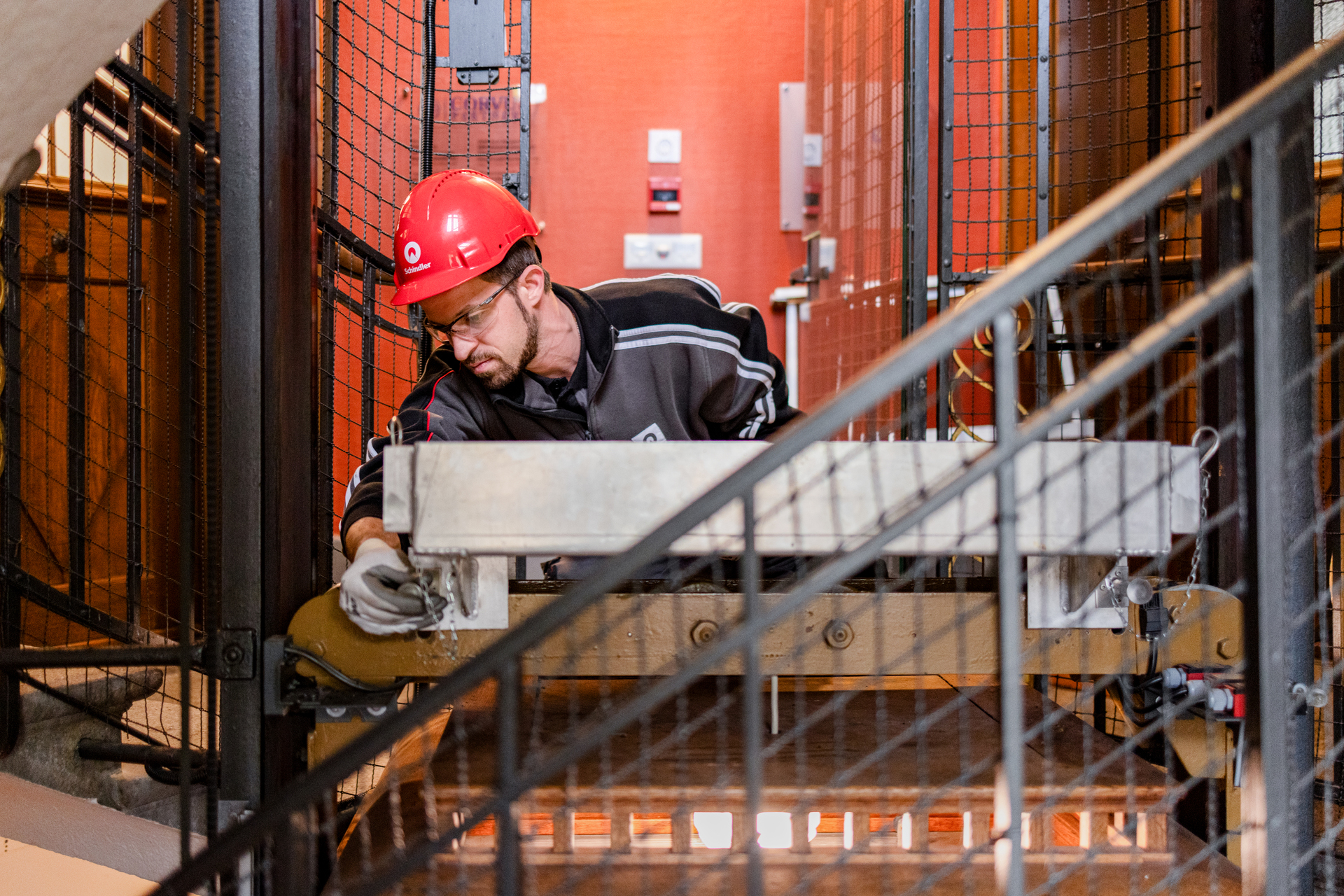
For mechanics and apprentices, the practical inference is that experience on existing installations matters alongside new-construction work. A modernization crew may have to understand an older controller and door system before fitting replacement equipment; a service mechanic works with the installed base long after construction ends. The growing order books suggest a continuing pipeline, but a booked project is not yet a scheduled job for a particular branch or crew.
There is a limit to what global results can tell a worker in Canada. None of these releases establishes how many modernization jobs will reach Winnipeg, how many apprentices a Canadian branch will hire, or what staffing will look like after the proposed KONE–TKE combination. Those questions require local project and employment evidence. The merger itself remains subject to regulatory review; TKE says closing is expected no earlier than the second quarter of 2027. TKE’s transaction update
The direction, however, is difficult to miss. New buildings still need elevators. But for these four companies, much of the opportunity lies in the millions of elevators already moving people every day—and in the mechanics who keep them safe, reliable and useful as those buildings age.
Reading the numbers
- Sales or revenue: work recognized in the reporting period. A rising figure may reflect volume, pricing, business mix or currency effects.
- Orders: work won during the period; it does not mean the installation has been completed.
- Backlog: orders remaining to be delivered. It is a pipeline measure, not a count of available jobs in a particular city.
- Organic or local-currency growth: company-specific measures that remove some effects such as exchange rates or acquisitions. They should not be treated as identical across companies.
- Profit margins: TKE’s adjusted EBITDA margin, KONE’s adjusted EBIT margin, Schindler’s EBIT margin and Otis’s segment operating margin use different definitions and are not directly comparable.
Primary sources
TK Elevator — preliminary Q4 and FY2026 trading update, October 27, 2026
Otis — third-quarter 2026 results, October 28, 2026
KONE — January–September 2026 interim report, October 28, 2026
Schindler — key figures through September 30, 2026, released October 22, 2026 · Full press release (PDF)
Verification note (): Figures are drawn from the companies’ own releases. TKE’s fiscal year ended September 30; the other figures cited here are interim results. Growth rates use each company’s stated basis and are not converted into a common currency or accounting metric. Trade implications are editorial inferences, not company hiring forecasts.