INTERNATIONAL NEWS / TECHNOLOGY
Two Cars. One Shaft.
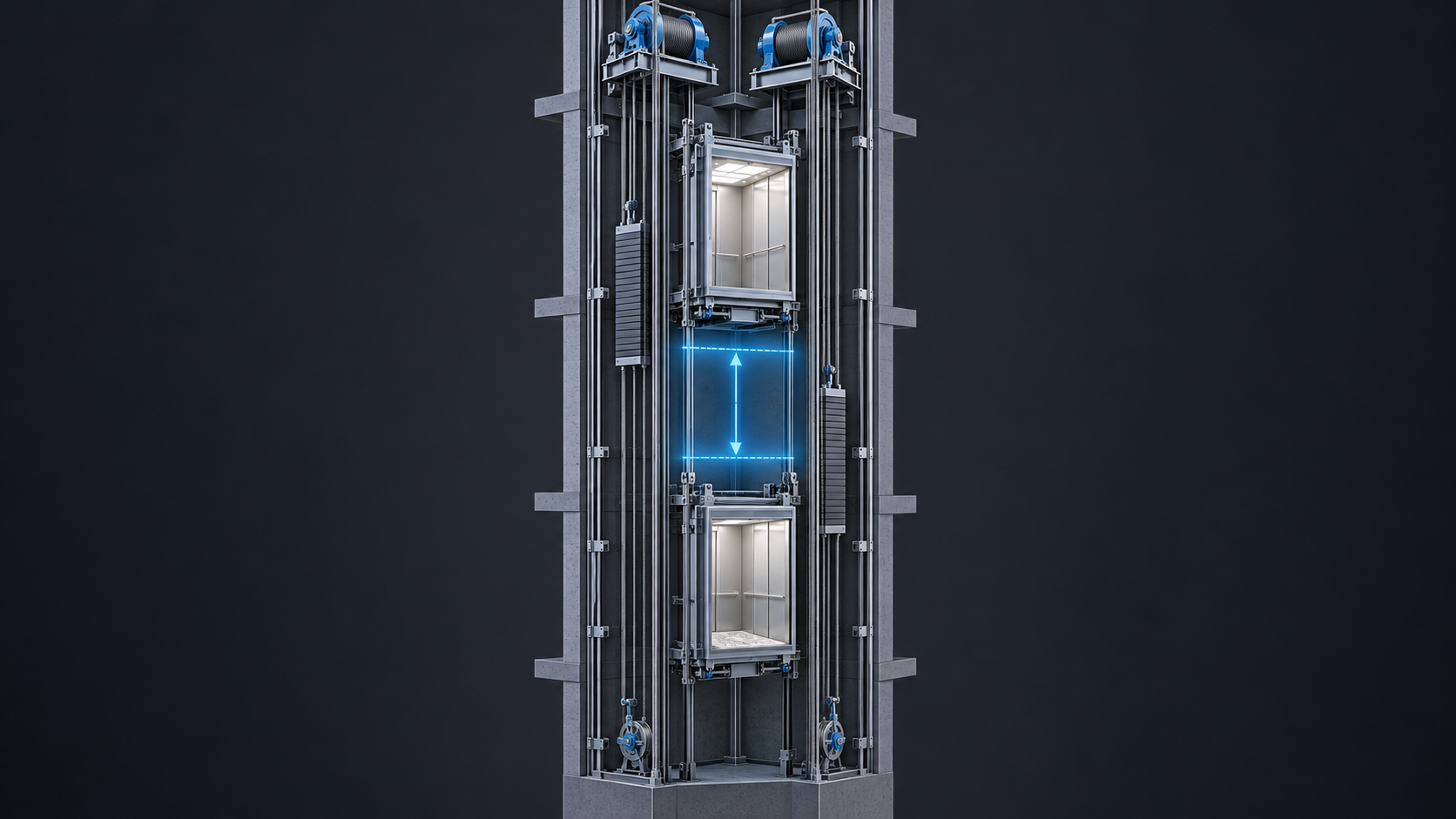
Every mechanic learns the basic picture: one hoistway, one car. TK Elevator’s TWIN system breaks that picture by putting two complete, independent cars in the same shaft. On October 28, the company introduced a new generation built around an AI-supported traffic system called AGILE Dispatcher. The machines are familiar. The software layer is the new story.
Not one car with two cabins
TWIN is not a double-deck elevator. It is two separate elevators sharing a corridor. Each car has its own traction machine, controller, ropes, counterweight and governor. What they share is the hoistway, including guide rails and landing doors.
The idea has been around for a long time. TK Elevator says the first TWIN installations began in 2003, after decades in which the two-car, one-shaft concept remained largely theoretical. Its practical value is straightforward: when a building cannot afford another shaft, the same core can carry more people.
That does not make it a simple retrofit. The shaft still needs the correct pit, overhead, entrances and clearances. In the standard arrangement, the lower and upper cars board from different access levels near the bottom of the building. The space between those levels gives the two cars the room they need to operate safely.
The safety case is the whole product
Two cars in one shaft only works if the system can keep the cars separated through every traffic pattern and fault condition. TWIN’s published safety concept is built in layers:
- Smart allocation: the dispatcher assigns calls so that the cars are not sent into a conflict.
- Distance monitoring: the system watches the gap and reduces speed when needed so a safe stop remains possible.
- Emergency stop: if the protected distance is breached, the system stops both drives and sets the brakes.
- Safety gear: as the final layer, the safety gear can engage on both cars.
TK Elevator says the system has TÜV certification and an EU Design Examination Certificate. Those are the company’s stated approvals for its European route; they are not a blanket approval for every jurisdiction around the world.
Why destination dispatch is not optional
The system depends on destination dispatch. Instead of pressing an up or down button and taking the next car, passengers enter their destination before boarding. The dispatcher groups passengers and sends them to a particular car.
That is both a traffic-management tool and part of the operating concept. A conventional collective-control system cannot make the same predictive allocation decisions. The new TWIN integrates TKE’s AGILE Dispatcher, which the company describes as AI-supported adaptive traffic management: it identifies traffic patterns and revises assignments in real time to reduce waiting and travel time.
TKE also says the system can park one car during low-traffic periods, operate the remaining car at gentler acceleration and use its MAX digital platform for condition monitoring and service planning. The company describes open API connections to building-management, access-control and security systems.
What the numbers mean — and what they do not
According to TKE, two cars in one shaft can move up to 40% more passengers while requiring up to 50% less elevator-core space than a conventional system, depending on the configuration. Those are manufacturer claims, not independent field measurements.
The new product line is designed for high-rise work. TKE lists cars rated from 1,250 to 1,800 kg, speeds from 3.0 to 7.0 m/s, travel up to 250 metres and up to 80 stops. The company says the new generation is available for planning in markets working to EN 81-20/50, including Europe, the Middle East, Latin America and specified areas of Asia. North America is not listed in that launch geography.
The technology is not only a rendering. TKE has previously pointed to TWIN installations such as 50 Hudson Yards in New York and the CODA Building at Georgia Tech. But the new AI-enabled generation is a product announcement, not evidence that every building is a candidate for it.
Could this happen in Manitoba?
Not by a normal catalogue order. Manitoba’s adopted elevator code is ASME A17.1/CSA B44:19. Its prescriptive provisions do not describe two independently operating cars in one hoistway. TKE’s published North American route refers to ASME A17.7/CSA B44.7, the performance-based safety code used for technologies that fall outside the main prescriptive code.
No Canadian TWIN installation or public Manitoba regulator decision was found for this article. A Manitoba proposal would therefore be a project-specific, performance-based approval question for the authority having jurisdiction — not a conclusion this publication can make. Winnipeg’s mostly low- and mid-rise stock is also not the high-rise environment for which TWIN was developed.
What owners and mechanics can take from it now
The immediate lesson is not “put two cars in one shaft.” It is that dispatch, software and data are now part of elevator capacity. Destination dispatch can be considered on ordinary elevator groups as a modernization tool, without building a TWIN shaft.
For owners, the story is a reminder that modernization proposals increasingly include traffic logic, remote monitoring, interfaces with building systems and software updates — not just motors, doors and ropes. For mechanics, the service scope increasingly includes a digital platform with its own lifecycle and cybersecurity requirements.
TWIN remains a specialised answer to a specialised building problem. But it is a clear view of the direction of travel: fewer new shafts, more performance squeezed from existing ones and more of the elevator’s decision-making happening in software.
Sources and verification
Additional technical background reviewed: TK Elevator TWIN global brochure (2026); ThyssenKrupp TWIN technical data sheet ST 61 (2012); TK Elevator’s prior project references for 50 Hudson Yards and CODA Building.
Manitoba ITS Bulletin 26-004 — Code Adoption for Elevating Devices
Capacity and core-space figures in this article are identified as manufacturer claims. This is general industry reporting, not a design, code or compliance opinion. Project-specific elevator approvals require the applicable authority having jurisdiction and licensed source documents.